Galerie Nordenhake Mexico City is pleased to present Zigzags and Curves, an exhibition by Sarah Crowner that brings together her sustained research into geometry, abstraction, and the expanded language of painting. Presented across two sites – the gallery’s Mexico City space and Casa Roja in Lomas de Chapultepec—the exhibition takes its title from the fundamental graphic elements that structure Crowner’s visual vocabulary: the zigzag and the curve.

Throughout her career, Crowner’s practice has been informed by the histories of modern art, including traditions of geometric abstraction that developed in Latin America during the twentieth century. She paints directly onto canvas that is then cut apart and sewn back together, allowing the act of making to remain embedded in the surface and structure of the work. At the intersection of fine art and design, and architecture, her work challenges hierarchies that position painting as an autonomous medium, instead extending it into architecture, scenography, and spatial experience. Her approach reflects a long-term engagement with Mexico’s cultural heritage, grounded in dialogue, observation, and admiration.
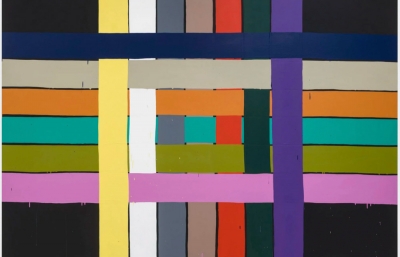
The presentation at Galerie Nordenhake Mexico City brings together a selection of works developed by Sarah Crowner in close dialogue with Galerie Nordenhake Mexico City partner Toni Sadurni, reflecting years of shared travel and research across Mexico and Latin America. Hard-edge geometries and linear structures recur throughout the installation, where zigzags and angular rhythms operate as both formal devices and compositional strategies. Participating artists include, Lygia Clark (Belo Horizonte, Brazil, 1920- 1988), Sandú Darié (Roman, Romania 1908 - Habana, Cuba 1991), Frida Escobedo (Mexico City, Mexico, 1979), Gerda Gruber (Bratislava, Austria, 1940), Graciela Iturbide (Mexico City, Mexico, 1942), Elena Izcue (Lima, Peru, 1889-1970), Thembi Nala (Kwa-Zulu-Natal, South Africa, 1973), Celso Renato (Rio de Janeiro, Brazil, 1919-1992), Fanny Sanín (Bogotá, Colombia, 1938), and John Zurier (Santa Monica, California, USA, 1956). Concepts such as gradient, scenario, and stagecraft become integral to the exhibition, echoing Crowner’s interest in how color and form operate physically and temporally. Yellow carpets and curtains introduce a scenographic dimension that activates movement through the space, while the graphic language of the zigzag draws from motifs encountered during Crowner’s extended stays in Mexico, including patterns found in pre-Hispanic visual languages and architectural sites such as Mitla and Tajín.
The exhibition continues at Casa Roja, located at Palmas 1535 in Lomas de Chapultepec, where Crowner presents of series of new paintings. Responding directly to the architecture
of the mid-century house, the work engages the site’s curved ceiling panels and fully red interior, unfolding an exploration of organic, biomorphic forms and fully red interior. Casa Roja’s monochromatic environment intensifies the bodily and perceptual experience of the exhibition, echoing Crowner’s ceramic practice and her interest in color as a spatial condition rather than a surface. The interaction between the artworks and the domestic architecture generates an environment in which form and color unfold gradually, integrating art into the spatial structure of the house.
Both venues employ natural lighting, a decisive factor for the artist, as light—being non-static—shifts throughout the day, constantly transforming our perception of the work and the environment, achieving a unity in chorus with nature. Taken as a whole, Zigzags and Curves project, as well as the artist’s broader approach, working with art history as a medium that allows her to choreograph proximities between Mexican culture, the historical revision of modernity, geometry, theater, and design. The project places special emphasis on the premises of Neo-Concretism, where two-dimensional works cease to be mere plans to become total artistic and pictorial experiences.