



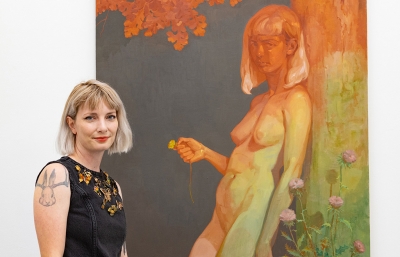
Public Gallery is pleased to present Sill, a solo exhibition of new painting and sculpture by Berlin-based artist Cathrin Hoffmann, whose subjects embody the physical intensity and psychological fatigue engendered by an age of information overload. No longer performing exaggerated gestures of desire or grotesque theatricality, Hoffmann’s figures inhabit states of sustained tension and accumulating pressure, sedimented in the threshold between endurance and action.
Hoffmann’s practice has long been concerned with states rather than subjects – her figures often hold durational poses, their confinement dictated by the limits of the canvas. In a marked formal shift, recent works turn toward the monochromatic: reddish-brown tones, from dark ochre to rust and clay, dominate the palette. Sill, the exhibition’s title, frames this shift and operates as both metaphor and site. Architecturally, a sill suggests a ledge – a place of pause and rest, but also of voyeuristic consumption. Geologically, it refers to a sheet of magma that intrudes into existing rock, cooling and solidifying in place. Evoking sedimentary layers and the earth’s core, the paintings’ sandy, coarse surfaces arrest the moving eye and resist the speed of digital consumption, embedding resistance within the stillness of Hoffmann’s figures and demonstrating an evolving concern for radical passivity.
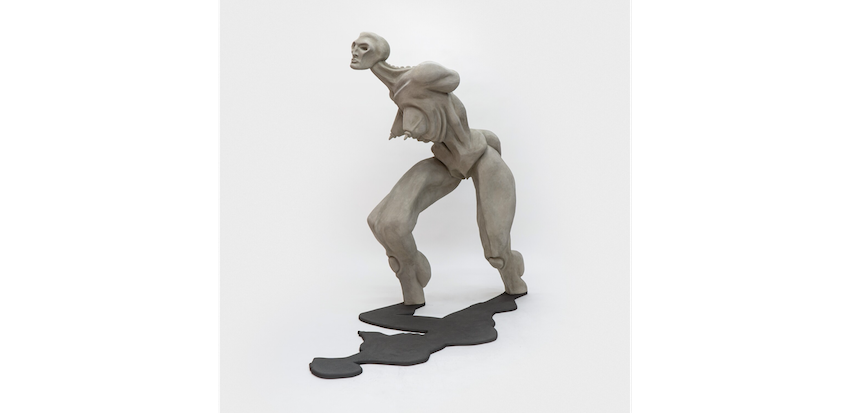
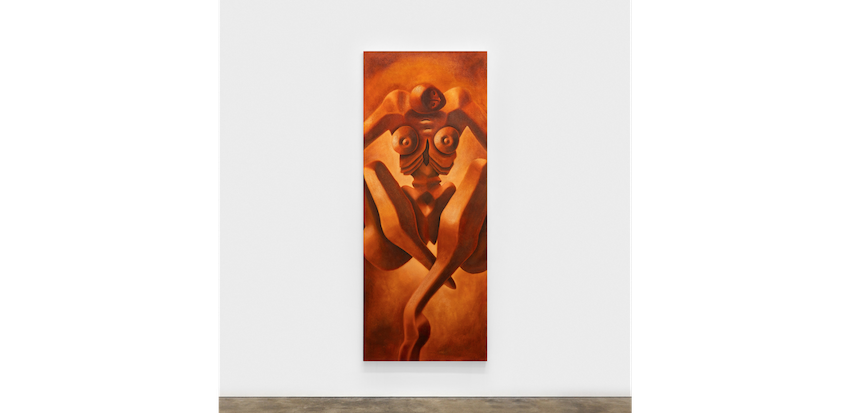
The exhibition is further grounded in the concept of acedia, an ancient term describing existential weariness where presence persists but is destabilized. It denotes a condition of wakefulness through endurance, a suspended potential where action remains conceivable yet cannot unfold. The concrete sculpture Reaching the Bottom and Calling It Height (2026) gives form to this condition, its twisted limbs, inverted torso, and curled toes compressing movement into stasis. In Don’t Forget My Shape (2026), the figure’s crossed legs and hunched back register this strain with particular intensity.
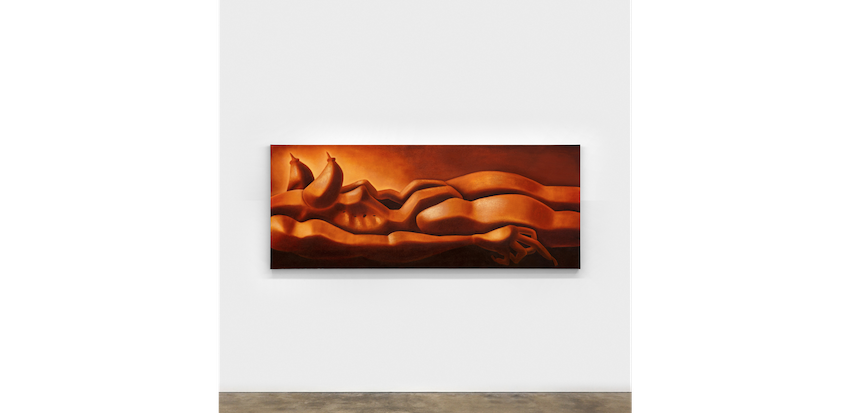
In The Glow That Keeps Us Awake (2026), an outstretched torso is reduced to a suspended present, capable only of the slightest extension of a single finger. Horizontality is emphasized not simply as a formal concern, but one that grounds the body in landscape. Hoffmann renders visible the paradox of our psychological condition: a heightened awareness set against increasingly diminished agency. Here, radical passivity takes on a new dimension, as a counter position to the demand of constant activity that governs our present moment.